
Machine Learning Applications in Disease Prediction and Prevention
Explore how machine learning is transforming disease prediction with AI risk models, predictive analytics, and personalised diagnosis — enabling early prevention across diabetes, cardiovascular disease, cancer, and more.
Overview
ML is revolutionising the field of healthcare through prediction of disease risk at an early stage, proper diagnoses, and customised treatment for patients. Through machine learning, analysis of healthcare data can be used to predict diseases early and facilitate better decision-making. Progress in LLMs, XAI, federated learning, multi-modal AI, digital twins, and wearables is accelerating this transformation.
Through artificial intelligence, modern medicine has experienced transformations such that doctors can now diagnose diseases early, make accurate predictions about patient risks, and implement prevention measures personalised for everyone. Within the broad scope of AI applications, machine learning (ML) is currently the leading technology used to help clinicians make decisions based on data analysis.
Machine learning algorithms can identify patterns from electronic health records, radiology images, laboratory test results, wearable devices, and genetics that cannot easily be noticed by people. Currently, machine learning algorithms for disease prediction are being used by healthcare practitioners to diagnose illnesses even before patients present signs. Disease prediction through machine learning is revolutionising modern medicine by diagnosing diabetes, cardiovascular diseases, and early cancer cases.
Why Machine Learning Matters in Disease Prediction
In contrast to traditional diagnostic tools, AI disease risk prediction models get better with each passing day as data accumulates, making medicine increasingly preventive rather than reactive. These advancements support improved early disease identification and enhance clinical accuracy through machine learning healthcare prediction systems.
How Machine Learning Improves Disease Prediction
How machine learning improves disease prediction lies in its ability to discover relationships among thousands of clinical variables simultaneously. Instead of relying solely on predefined medical rules, ML models learn patterns directly from patient datasets. These advanced disease prediction algorithms analyse complex healthcare information to improve prediction accuracy and clinical decision-making.
Typical Machine Learning Workflow
| Stage | Purpose |
|---|---|
| Data Collection | Gather patient records, laboratory tests, imaging, wearable sensor data |
| Data Cleaning | Remove missing values and inconsistencies |
| Feature Engineering | Select important clinical indicators |
| Model Training | Train algorithms using historical patient outcomes |
| Validation | Evaluate prediction accuracy and clinical reliability |
Common Machine Learning Algorithms Used in Disease Prediction
Different diseases require different predictive approaches depending on data complexity. The following algorithms power many advanced disease prediction solutions across hospitals and research institutions:
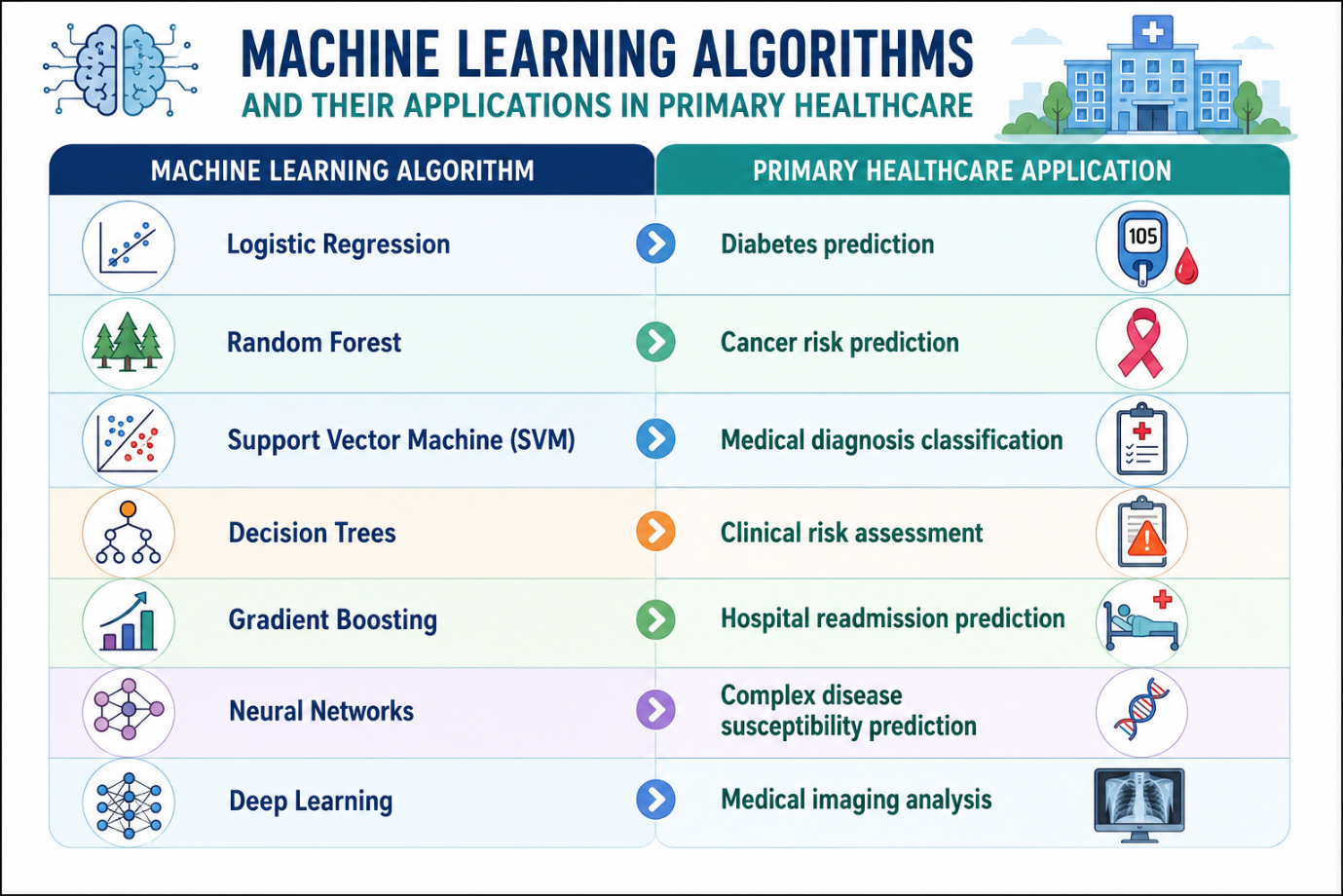
Real-World Applications of Machine Learning in Healthcare
Machine learning has already moved beyond the laboratory and is being implemented into clinical practice through advanced machine learning healthcare prediction solutions.
Diabetes Prediction
Predictions of diabetes are made by analysing age, BMI, glucose, insulin resistance, lifestyle, and heredity of patients. These predictions help reduce the risks of developing diabetes through early intervention via diet changes and physical exercise. This is one of the best examples of disease susceptibility prediction ML, where patient characteristics are analysed to identify individuals who may develop diabetes in the future.
Deep Learning Cardiovascular Disease Prediction
Deep learning cardiovascular disease prediction is a fast-evolving area based on analysis of medical information. Deep neural networks process ECG signals, echocardiography, blood pressure, lipid profiles, and data from heart monitors to predict heart attacks weeks before they happen. AI-assisted ECG interpretation systems detecting hidden heart anomalies have already been introduced by several hospitals worldwide.
Cancer Prediction
Machine learning algorithms help doctors detect abnormalities in CT scans, MRI, pathology slides, and genomics data. Applications span breast cancer, lung cancer, skin cancer, and colorectal cancer. This technology enhances early diagnosis and reduces unnecessary biopsy procedures by improving AI disease risk prediction models.
Infectious Disease Surveillance
Predictive models examine travel behaviour, weather information, population mobility, public health reports, and hospitalisations. Such models help predict the onset of disease outbreaks and support resource allocation in healthcare systems — enabling earlier, more coordinated public health responses.
Disease Susceptibility Prediction Using Machine Learning
Today's healthcare is becoming increasingly inclined towards finding people who could become sick prior to the manifestation of symptoms. Disease susceptibility prediction ML focuses on analysing multiple health indicators to estimate future disease risks.
Benefits of Predictive Modelling in Healthcare
Predictive modelling is fast becoming an integral part of digital healthcare systems through advanced predictive analytics disease diagnosis approaches:
Timely Diagnosis
Early identification of disease risk before symptoms manifest.
Lifesaving Interventions
Critical alerts for at-risk patients enable preventive care before crises.
Customised Preventive Care
Personalised prevention plans based on individual health profiles.
Efficient Resource Use
Better allocation of healthcare resources through demand prediction.
Hospitalisation Savings
Reduced admissions and readmissions through proactive management.
Faster Clinical Decisions
AI-powered support tools accelerate evidence-based decision-making.
Wearable Monitoring
Continuous health tracking enables real-time intervention triggers.
Healthcare Efficiency
Streamlined workflows improve throughput and care quality simultaneously.
Challenges in Machine Learning Healthcare Prediction
Despite its advantages, several challenges remain before large-scale implementation of disease prediction algorithms in healthcare systems:
| Challenge | Impact |
|---|---|
| Poor data quality | Reduces model accuracy and reliability |
| Data privacy concerns | Limits cross-institutional data sharing |
| Algorithm bias | May affect prediction fairness across demographics |
| Limited clinical validation | Slows adoption in real-world healthcare settings |
| Lack of explainability | Reduces physician trust in AI recommendations |
| Regulatory compliance | Requires extensive validation before deployment |
Future of Disease Prediction Using Machine Learning Algorithms
Medicine is quickly moving towards becoming a field that is predictive, preventive, personalised, and participatory (P4). The technologies driving this shift — LLMs, XAI, federated learning, multimodal AI, digital twins, and wearables — have all become possible through machine learning algorithms that ensure improved disease diagnosis and prediction.
Large Language Models
LLMs enabling natural language queries over clinical data and notes.
Explainable AI (XAI)
Transparent predictions that clinicians can audit and trust.
Federated Learning
Cross-institution learning without sharing raw patient data.
Multimodal AI
Combining genomics, imaging, and clinical data for richer predictions.
Digital Twins
Virtual patient models for simulating treatment responses.
Wearable Integration
Real-time physiological data feeding continuous predictive models.
Conclusion
Machine learning is revolutionising modern healthcare by changing the emphasis from treatment to prevention. Machine learning healthcare prediction allows medical practitioners to predict risky patients, increase diagnostic accuracy, and provide personalised interventions based on patient health profiles.
Predictive analytics disease diagnosis, deep learning cardiovascular disease prediction, diabetes prediction, and cancer prediction are some of the applications showing how artificial intelligence is helping the field become more efficient and effective. With increasing adoption of predictive modelling in healthcare organisations, the application of AI disease risk prediction models and disease susceptibility prediction ML will remain at the core of progress in Disease Prediction, Disease Prevention, and Medical Diagnosis. Even though challenges remain regarding data quality, transparency, and regulatory compliance, technological innovations continue paving the way for more precise and explainable AI healthcare solutions.
Reference
Al Meslamani, A. Z., Sobrino, I., & de la Fuente, J. (2024). Machine learning in infectious diseases: potential applications and limitations. Annals of Medicine, 56(1), 2362869. https://doi.org/10.1080/07853890.2024.2362869