
The Role of Artificial Intelligence in Modern Public Health Systems
Explore how AI is transforming public health through disease surveillance, predictive analytics, early detection, and smarter healthcare planning — from outbreak forecasting to population-wide prevention.
Overview
Artificial intelligence is revolutionising public health through better disease detection, diagnoses, disease surveillance, and healthcare planning. Through data analysis from big data in healthcare, AI aids in making quick decisions, disease outbreak prediction, and resource allocation — transforming how governments and health agencies protect entire populations.
One of the most transformational technologies in healthcare today is Artificial Intelligence in Public Health Systems, which helps public health departments diagnose illnesses early, maximise healthcare resources, aid in making clinical decisions, and develop effective disease surveillance programmes. With the exponential increase in healthcare data, conventional techniques are becoming inadequate to identify new public health threats and predict disease outbreaks.
Modern-day AI in healthcare systems is bringing significant changes to population health management by governments, hospitals, research institutions, and public health agencies through the integration of machine learning public health models and big data analytics.
Why Artificial Intelligence Matters in Public Health
Public health is concerned with safeguarding an entire population as opposed to individuals alone. There is a need for better healthcare solutions considering rising population growth, ageing populations, new diseases, and chronic conditions. AI provides a way of deriving valuable information from unorganised healthcare data. Key objectives include:
Evolution of AI in Public Health
| Era | Healthcare Approach | AI Contribution |
|---|---|---|
| Traditional Healthcare | Manual record analysis | Limited predictive capability |
| Digital Healthcare | Electronic Health Records (EHRs) | Data digitisation |
| AI-Driven Healthcare | Machine learning algorithms | Intelligent diagnosis and forecasting |
| Smart Public Health | Predictive analytics and automation | Population-wide disease prevention |
Major Applications of AI in Modern Public Health Systems
AI Disease Diagnosis
One of the most important applications is AI disease diagnosis, which uses deep learning technologies to analyse medical images, pathology samples, laboratory results, and clinical information with high accuracy. AI helps doctors detect anomalies, improving diagnostic accuracy and decreasing the time needed for making diagnoses.
Machine Learning in Public Health
Machine learning public health models use patient information along with environmental, lifestyle, and demographic data to identify disease risk patterns. As more healthcare data becomes available, these models improve prediction accuracy continuously.
Predictive Analytics in Healthcare
Predictive analytics healthcare solutions enable providers to forecast future health events using historical and real-time data. These models help hospitals optimise resources and improve patient care — identifying high-risk patients in advance, lowering emergency admissions, improving healthcare planning, and enabling treatment prioritisation.
AI Epidemiology Surveillance
There have been huge improvements in disease surveillance through AI applications that help health officials track infectious diseases in real-time. AI combines information from hospital data, laboratory information, wearable devices, environmental sensors, travel patterns, and even internet search trends to spot outbreaks before they are reported traditionally.
AI Technologies Supporting Public Health
| AI Technology | Public Health Application | Primary Benefit |
|---|---|---|
| Machine Learning | Disease prediction | Early intervention |
| Deep Learning | Medical image analysis | Improved diagnostic accuracy |
| Natural Language Processing | Electronic health record analysis | Faster clinical insights |
| Computer Vision | Radiology interpretation | Accurate disease detection |
| Predictive Analytics | Outbreak forecasting | Better preparedness |
| Robotics & Automation | Laboratory testing | Increased efficiency |
Benefits of AI in Public Health Systems
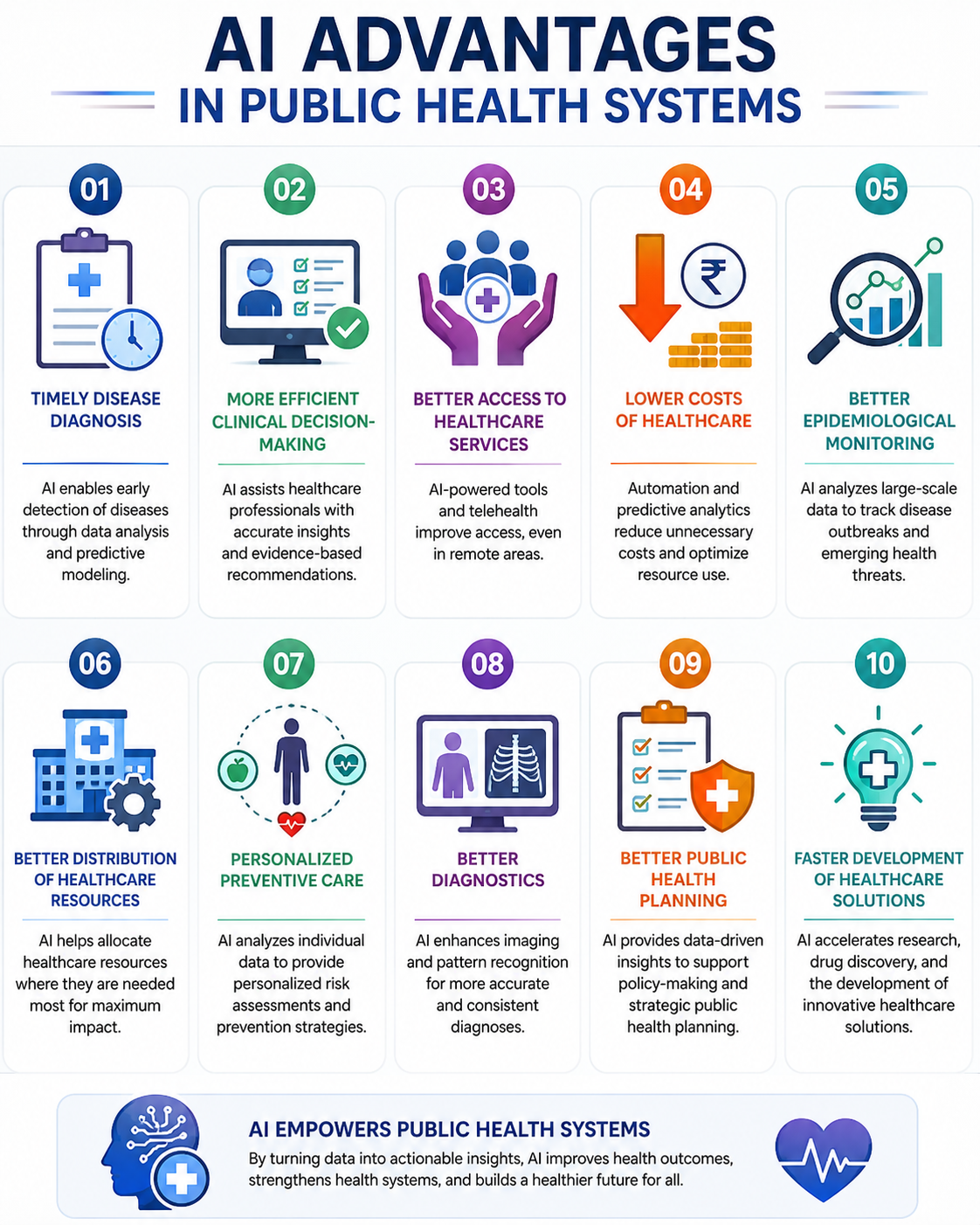
With the increasing use of AI, we can see noticeable gains in the healthcare industry all over the world. The following infographic summarises the ten key advantages of AI in public health:
Machine Learning Disease Prediction Models
One of the fastest growing research domains relates to machine learning models for disease prediction that can identify at-risk patients even before the manifestation of symptoms. These models use diverse datasets including:
Health organisations use such knowledge to provide prevention-based treatment instead of reactive treatment — shifting the entire care model towards a proactive, data-driven paradigm.
AI Early Disease Detection Systems
Current AI early disease detection systems can detect small biological changes which may indicate the occurrence of any disease even before its symptoms occur. Key applications include:
Real-World AI Success Stories
| Organisation | AI Application | Public Health Impact |
|---|---|---|
| Google DeepMind | Eye disease diagnosis | Improved diabetic retinopathy detection |
| Johns Hopkins Applied Physics Laboratory | Pandemic forecasting models | Enhanced outbreak preparedness |
| UK National Health Service (NHS) | AI-assisted radiology | Faster imaging interpretation |
| BlueDot | Global infectious disease monitoring | Early outbreak detection and surveillance |
Challenges of Implementing AI in Public Health
Even though there is immense scope, overcoming certain important challenges is necessary for successful deployment:
The Future of AI in Public Health
The future of public health will depend increasingly on smart technologies that will be able to analyse huge amounts of healthcare data in real-time. The development of clinical intelligence, explainable AI, federated learning, and digital health ecosystems is likely to increase the efficiency of clinical decision-making and help with disease prevention and global epidemiological surveillance. With the growing implementation of AI technology in the field, it is expected to become an integral part of healthcare systems in the future.
Conclusion
Introduction of artificial intelligence into the realm of public health is revolutionising how diagnoses, disease predictions, surveillance, and healthcare planning can be accomplished. Using AI disease diagnosis, machine learning in public health, predictive analytics healthcare, and AI epidemiology surveillance, intelligent technology is allowing for effective decision-making by healthcare practitioners while making significant contributions towards improved population health.
Although there are many challenges associated with data governance and ethical considerations, the development and adoption of innovative solutions in these areas will lead to the emergence of new avenues within the sphere of healthcare innovation and clinical intelligence.
References
Bajwa, J., Munir, U., Nori, A., & Williams, B. (2021). Artificial intelligence in healthcare: transforming the practice of medicine. Future Healthcare Journal, 8(2), e188–e194. https://doi.org/10.7861/fhj.2021-0095