
AI-Driven Innovations in Precision Medicine and Healthcare Delivery
Discover how AI-driven precision medicine improves diagnostics, treatment decisions, and healthcare delivery systems — from genomics to real-world clinical applications.
Overview
The traditional way of providing healthcare services through standardised approaches to treatment is changing, rapidly evolving into the era of individualised medicine where treatment protocols are customised based on an individual's genetic makeup, living conditions, exposure, and medical history. This change is being driven by AI advancements that allow healthcare professionals to analyse huge amounts of genomic and clinical data at incredible speed and accuracy.
In today's world, the application of AI-driven precision medicine is helping health professionals make evidence-based decisions, reduce unnecessary procedures, predict risks, and improve patient outcomes. From precision oncology to cardiology and rare disease diagnosis, AI is making things easier for healthcare practitioners at every level of the care pathway.
What Is AI-Driven Precision Medicine?
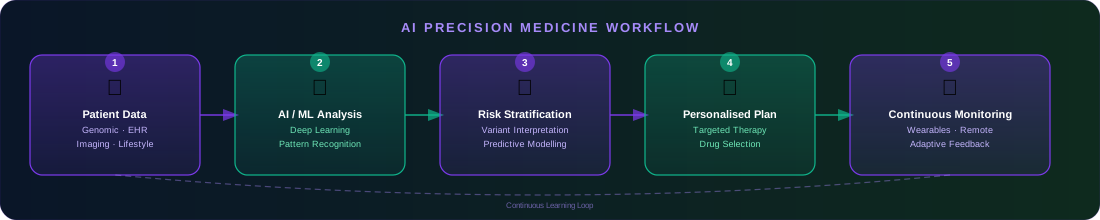
Precision medicine uses information from the patient's clinical history and genomic, molecular, imaging, and lifestyle data to tailor very personalised therapies for the individual. AI augments precision medicine by using advanced machine learning techniques to discover subtle patterns in patient data from millions of patients that would go unnoticed otherwise.
Rather than relying solely on generic clinical guidelines, an AI model keeps learning from new patient data, making it easier for doctors to predict each patient's reaction to treatment — enabling smarter, safer, and faster clinical decisions.
How AI Powers Precision Medicine
| AI Capability | Clinical Application | Patient Benefit |
|---|---|---|
| Machine Learning | Predicting disease progression | Earlier intervention |
| Deep Learning | Medical image interpretation | Improved diagnostic accuracy |
| Natural Language Processing | Extracting insights from EHRs | Faster clinical decision-making |
| Predictive Analytics | Personalised treatment recommendations | Better therapeutic outcomes |
| Genomic AI | Variant interpretation | Precision drug selection |
| Clinical Decision Support | Risk stratification | Reduced medical errors |
These technologies collectively strengthen Precision Diagnostics AI, allowing clinicians to deliver individualised care supported by data-driven evidence.
Precision Medicine AI Applications Across Healthcare
AI has evolved from its role in diagnostics and is now an essential component of current healthcare environments. Precision medicine AI applications are helping healthcare professionals develop more accurate diagnostic methods, targeted therapies, and personalised treatment strategies.
Precision Oncology
One of the biggest changes in cancer treatment. Using pathology reports, radiological images, genome sequencing, and medical history, AI identifies tumour mutations and suggests targeted treatments. Scientists and doctors use AI models with genome sequencing to find actionable mutations in breast, lung, and colon cancers.
Precision Diagnostics
AI aids radiologists in detecting the slightest abnormalities in CT scans, MRI, retinal scanning, and pathology slides that may not be visible to the naked eye. Modern health facilities use Precision Diagnostics AI for faster, more accurate reporting.
Precision Cardiology
AI interprets ECGs, data from wearable devices, cardiac images, and patient history to determine cardiovascular risks before they become severe. AI-based prediction models help cardiologists identify at-risk patients and tailor treatment methods accordingly.
AI Healthcare Delivery Systems: Transforming Clinical Operations
Beyond aiding in clinical decisions, AI healthcare delivery systems enhance hospital management, resource allocation, and patient engagement. Key areas of healthcare delivery optimisation include:
Real-World Examples of AI in Healthcare
| Organisation | AI Innovation | Clinical Impact |
|---|---|---|
| Mayo Clinic | AI-assisted cardiovascular diagnostics | Earlier cardiac risk prediction |
| Memorial Sloan Kettering Cancer Centre | AI-supported oncology decision support | Personalised cancer treatment planning |
| NHS (United Kingdom) | AI imaging analysis | Faster radiology reporting |
| Cleveland Clinic | Predictive analytics | Reduced hospital readmissions |
| Stanford Medicine | AI sepsis prediction models | Earlier critical care intervention |
AI Precision Medicine Implementation Strategies
For successful implementation of AI in precision medicine, healthcare providers need holistic approaches encompassing clinical, data, and regulatory dimensions. Best practices include:
Precision Medicine Data Integration Challenges
Despite significant progress, healthcare organisations continue facing several precision medicine data integration challenges:
| Challenge | Impact | Potential Solution |
|---|---|---|
| Fragmented healthcare data | Incomplete patient profiles | Unified data platforms |
| Genomic data complexity | Slower interpretation | AI-assisted genomic analytics |
| Data privacy regulations | Limited data sharing | Secure federated learning |
| Inconsistent data quality | Reduced AI accuracy | Standardised data governance |
| Legacy IT infrastructure | Difficult integration | Cloud-enabled healthcare platforms |
AI Healthcare Delivery Workflow Optimisation
Modern hospitals have increasingly adopted AI healthcare delivery workflow optimisation to enhance the efficiency of clinical and administrative processes. Key advantages include:
Faster Documentation
Decreased time for clinicians' administrative documentation through AI-assisted note generation.
Rapid Lab Results
Fast interpretation of laboratory results with automated flagging of critical values.
Automated Referrals
Intelligent referral routing reduces delays and improves specialist matching.
Smart ED Triage
Smart prioritisation of cases in emergency departments based on AI-assessed acuity.
Better Discharge Planning
AI-powered discharge planning reduces readmissions and improves care transitions.
Care Coordination
Multidisciplinary care coordination enhanced through unified AI-driven care plans.
Future Trends Shaping Precision Medicine
Several innovations are set to transform the future of healthcare over the next decade, further strengthening AI-driven precision medicine:
Multimodal AI
Using genomic, imaging, and clinical information simultaneously for holistic insights.
Digital Twins
Simulated patient models for testing treatments before clinical application.
Federated Learning
Private AI collaboration across institutions without sharing raw patient data.
Explainable AI
Transparent AI reasoning that builds confidence and trust among clinicians.
AI Drug Discovery
Accelerating identification of novel therapeutic compounds and drug repurposing.
Wearable Monitoring
Constant real-time patient monitoring through AI-powered wearable devices.
Disease Prediction
Population-level predictive models for early disease identification and prevention.
LLM Clinical Support
Large language models used in clinical decision support and medical knowledge retrieval.
Conclusion
AI is revolutionising healthcare delivery through enhanced diagnosis, personalised treatment plans, and streamlined operations. From Precision Oncology and Precision Diagnostics to Precision Cardiology, AI allows healthcare providers to leverage data to make decisions which improve patient care while eliminating inefficiency.
Despite ongoing Precision Medicine data integration challenges, rapid developments in healthcare data interoperability, machine learning models, and secure healthcare data platform solutions are driving adoption. By embracing AI precision medicine implementation strategies and optimising AI healthcare delivery workflows, providers can build resilient healthcare delivery systems ready for the future precision medicine era.
References
Olawade, D. B., David-Olawade, A. C., Wada, O. Z., Asaolu, A. J., Adereni, T., & Ling, J. (2024). Artificial intelligence in healthcare delivery: Prospects and pitfalls. Journal of Medicine, Surgery, and Public Health, 3(100108), 100108. https://doi.org/10.1016/j.glmedi.2024.100108