
AI-Powered Early Detection Strategies for Chronic Diseases
AI for early disease detection is transforming chronic disease management by analyzing medical records, imaging, wearable data, and lab results to identify health risks before symptoms appear.
Overview
AI-powered early disease detection is transforming chronic disease management by analyzing medical records, imaging, wearable device data, and laboratory results to identify health risks before symptoms appear. Through predictive analytics and machine learning, healthcare providers can deliver earlier diagnoses, personalized treatments, and proactive interventions, leading to improved patient outcomes, reduced healthcare costs, and more effective preventive care.
Many of the chronic diseases such as heart disease, diabetes, chronic kidney disease, chronic respiratory diseases, and cancer form most of the expenses that healthcare incurs globally, as well as the mortality rate. Traditional methods have relied on clinical signs of these diseases before diagnosing patients.
AI for Early Disease Detection is changing preventive care through analysis of medical data, medical imagery, data from wearable devices, genetic makeup, and laboratory test results. AI allows health practitioners to make timely and informed decisions, as well as providing improved patient care through personalized solutions.
This article covers how AI algorithms for disease prediction are changing healthcare, the use of predictive analytics for chronic diseases, applications in clinical practice, case studies on AI-assisted early detection systems, and issues surrounding implementation.
Why AI Matters in Early Disease Detection
The healthcare sector produces vast amounts of patient data daily. Yet, most of such data is underused without proper analysis through intelligence systems. AI addresses this problem by detecting the underlying patterns, revealing signs of diseases and making future predictions which would not be seen by standard statistical methods.
How AI Detects Chronic Diseases Earlier
AI combines machine learning, deep learning, computer vision, and predictive modelling to analyse structured and unstructured healthcare data. These AI algorithms for disease prediction enable clinicians to identify health risks earlier than conventional diagnostic approaches.
| AI Technology | Healthcare Application | Clinical Benefit |
|---|---|---|
| Machine Learning | Disease risk prediction | Identifies high-risk patients |
| Deep Learning | Medical image analysis | Detects abnormalities with high accuracy |
| Natural Language Processing | Electronic Health Record analysis | Extracts valuable clinical insights |
| Predictive Analytics | Disease progression forecasting | Enables preventive interventions |
| Computer Vision | Radiology and pathology interpretation | Improves diagnostic precision |
| Wearable AI | Continuous health monitoring | Detects early physiological changes |
AI Applications Across Major Chronic Diseases
Cardiovascular Disease
AI models analyse:
- ECG readings
- Echocardiograms
- Blood pressure readings
- Lipid profiles
- Monitoring data of the heart
Diabetes Forecasting
AI models analyse:
- Glucose levels
- BMI
- History of relatives
- Lifestyle
- Laboratory indicators
- Continuous glucose monitoring data
Chronic Kidney Disease
AI models analyse:
- Creatinine values
- eGFR levels
- Presence of protein in urine
- Blood pressure trends
- History of medication intake
Cancer Detection
AI models analyse:
- Mammograms
- CT scans
- MRI scans
- Histopathology slides
- Genomics sequencing
AI Workflow for Early Disease Detection
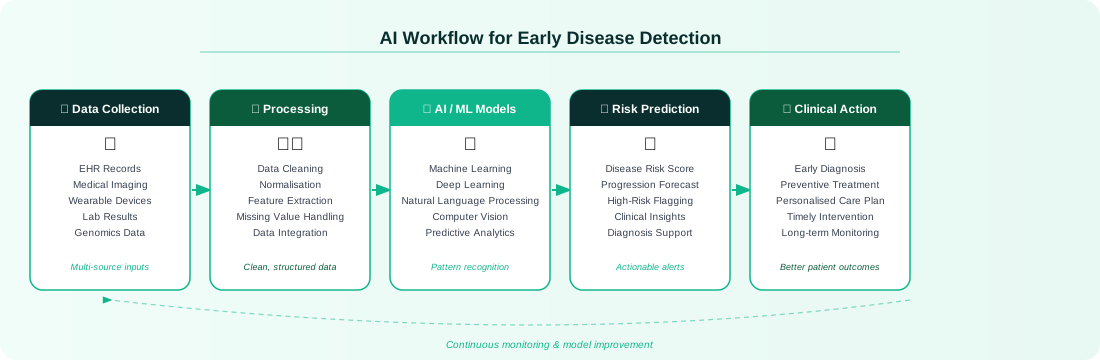
AI-powered early disease detection begins by collecting data from electronic health records, wearables, medical imaging, and laboratory tests. After cleaning and processing the data, machine learning models identify key clinical patterns to predict disease risk. These predictions support early diagnosis, clinical decision-making, and timely intervention, while continuous monitoring enables effective long-term disease management.
The Role of Predictive Analytics for Chronic Diseases
Predictive analytics for chronic diseases help healthcare providers plan for future health occurrences rather than merely reacting to current situations. Hospitals use predictive models in clinical processes to identify those patients who need preventive care immediately.
AI in Chronic Disease Management
AI in Chronic Disease Management is not only about diagnosis but also involves continuous monitoring of health and helping doctors optimise treatments.
These features improve the impact of AI on patient outcomes in chronic disease management by enabling proactive care, personalised treatment, and better long-term health outcomes.
Why Data Quality Determines AI Success
No matter how sophisticated any AI system may be, it relies on quality health care data. Low-quality databases lead to biased results, poor predictive power, and can negatively affect clinical decision making.
Key Attributes of Quality Databases
This highlights the importance of data quality in AI for chronic disease, ensuring accurate predictions and reliable clinical decision-making.
Challenges in Implementing AI for Early Disease Detection
Although there are certain benefits that come along with AI, adopting the technology requires proper planning. Overcoming these barriers is necessary for the safe and ethical use of AI.
Conclusion
AI for Early Disease Detection is reimagining the way chronic conditions are diagnosed and treated through early detection and personalized care. With the help of smart prediction, intelligent image processing, and constant monitoring of patients, medical practitioners can take necessary action much earlier to provide better care and save costs in the process.
The continued adoption of predictive analytics for chronic diseases, supported by high-quality healthcare data and robust clinical validation, will further strengthen AI in Chronic Disease Management. As demonstrated through emerging case studies on AI-assisted early detection systems, artificial intelligence is expected to play an increasingly important role in improving healthcare outcomes and enabling more proactive disease prevention.
References
Dong, C., Ji, Y., Fu, Z., Qi, Y., Yi, T., Yang, Y., Sun, Y., & Sun, H. (2025). Precision management in chronic disease: An AI empowered perspective on medicine-engineering crossover. iScience, 28(3), 112044. https://doi.org/10.1016/j.isci.2025.112044