
Artificial Intelligence in Clinical Decision-Making and Patient Care: How AI Is Transforming Modern Healthcare
Discover how AI transforms clinical decision-making with CDSS, predictive analytics, and personalized care to improve diagnosis and patient outcomes in modern healthcare.
Overview
Artificial Intelligence (AI) is transforming clinical decision-making by helping healthcare professionals diagnose diseases more accurately, predict patient risks, personalize treatments, and improve overall patient care. Through technologies such as Clinical Decision Support Systems (CDSS), predictive analytics, and machine learning, AI enables faster, data-driven decisions while reducing errors and enhancing healthcare efficiency.
There is an upcoming era in healthcare where Artificial Intelligence in Clinical Decision-Making is becoming an indispensable companion in the field of clinical practice. With its help, doctors can be assisted in disease diagnosis, predict the state of patients, give suggestions about personalised treatment options, and more. As there is a huge amount of data that hospitals produce every day — from EHRs to lab test results and medical imaging data — healthcare professionals need intelligent systems to transform all this raw information into clinical intelligence.
This blog will cover Artificial Intelligence in Clinical Decision Making and Care and explain the impact of Clinical Decision Support Systems (CDSS), Predictive Analytics in Healthcare, AI for Chronic Disease Management, and AI for Medical Decision Making on patient care.
What Is Artificial Intelligence in Clinical Decision-Making?
AI in clinical decision-making means that machine learning, deep learning, NLP, and predictive modelling can be used to help doctors make fast, efficient, and evidence-based decisions related to patient care.
Key distinction: AI does not replace the doctors; rather, it works as a smart support system — analysing complicated patient data, discovering hidden patterns, calculating clinical risk factors, and making suggestions on appropriate actions.
Why Artificial Intelligence Matters in Patient Care
The modern healthcare industry faces challenges including increased patient numbers, shortage of doctors, rising healthcare costs, and complex disease management. AI helps solve these problems through clinical process improvement and evidence-based treatments.
Core Technologies Driving AI in Healthcare
| AI Technology | Healthcare Application | Clinical Benefit |
|---|---|---|
| Machine Learning | Disease prediction | Identifies patient risk earlier |
| Deep Learning | Medical image interpretation | Improves diagnostic precision |
| Natural Language Processing | EHR analysis | Extracts valuable clinical insights |
| Computer Vision | Radiology and pathology | Detects abnormalities automatically |
| Predictive Analytics | Hospital admission forecasting | Enables proactive care planning |
| Generative AI | Clinical documentation | Reduces physician administrative burden |
Clinical Decision Support Systems (CDSS): The Foundation of AI-Powered Healthcare
One of the most significant applications of AI is the development of Clinical Decision Support Systems (CDSS). These intelligent platforms combine patient records, clinical guidelines, laboratory findings, imaging results, and predictive models to assist physicians throughout the decision-making process.
How Clinical Decision Support Systems Work
Patient Assessment
AI: Collects clinical information
Result: Comprehensive patient profile
Data Analysis
AI: Identifies hidden patterns
Result: Accurate risk prediction
Clinical Recommendation
AI: Suggests evidence-based interventions
Result: Improved treatment decisions
Continuous Monitoring
AI: Tracks patient progress
Result: Early detection of deterioration
Clinical Decision Support Systems help physicians make informed decisions without replacing clinical expertise.
Predictive Analytics in Healthcare
Predictive analytics in healthcare utilises data about patients' past and current states to predict future medical events. More health institutions apply predictive models to spot patients at risk for certain complications or hospital readmissions.
Advantages
Applications
AI for Chronic Disease Management
Managing chronic diseases requires continuous monitoring and personalized treatment. AI for Chronic Disease Management enables healthcare providers to deliver proactive care rather than reactive treatment. AI also integrates wearable devices, mobile health applications, and remote monitoring systems to provide continuous patient care beyond hospital settings.
| Chronic Disease | AI Application | Patient Benefit |
|---|---|---|
| Diabetes | Glucose prediction algorithms | Better blood sugar control |
| Hypertension | Blood pressure monitoring | Reduced cardiovascular risk |
| Heart Failure | Remote patient monitoring | Early intervention |
| COPD | Predictive symptom analysis | Prevents disease exacerbation |
| Chronic Kidney Disease | Risk prediction models | Slows disease progression |
AI for Medical Decision Making
AI for Medical Decision Making helps doctors make decisions related to diagnosis, treatment, drug prescription, and patient monitoring. Doctors receive recommendations from AI based on millions of past cases along with evidence-based guidelines — freeing them to focus time on patients while AI analyses complex data.
Real-World Examples of AI in Clinical Decision-Making
Mayo Clinic
AI-based predictive models enable medical experts to detect at-risk patients who may have heart-related issues based on analysis of electronic health records.
Cleveland Clinic
AI machine learning models allow doctors to detect patients with symptoms of sepsis and start treatment well before time.
NHS (UK)
AI-based medical image technology enables radiologists to detect breast cancer and lung problems with greater accuracy and speed.
How Artificial Intelligence Improves Clinical Decision-Making
The AI-driven clinical workflow combines patient information, predictive analytics, and evidence-based recommendations to support faster and more accurate healthcare decisions.
Challenges and Future Trends of AI in Clinical Decision Support
AI is quite effective, but its implementation faces various issues which should be sorted out. Healthcare organizations must develop proper governance structures to maintain the effectiveness of AI systems.
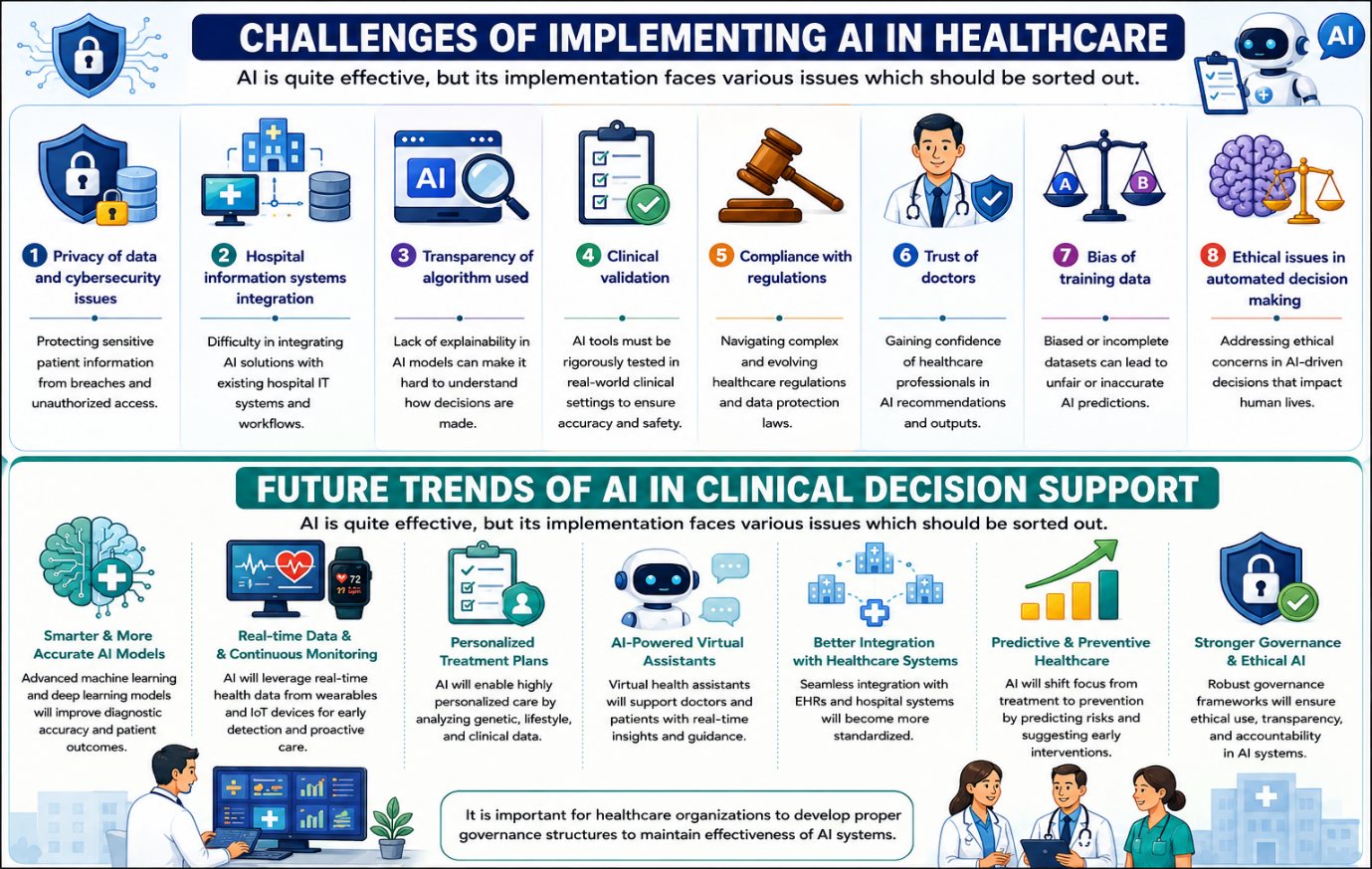
The future trends of AI in clinical decision support include explainable AI, federated learning, multimodal AI, and real-time clinical intelligence — enabling safer, smarter, and more efficient patient care.
Conclusion
The advent of Artificial Intelligence in Clinical Decision-Making and patient care is helping the healthcare industry deliver precise diagnosis, preventive intervention, and personalised treatment. This is made possible using Clinical Decision Support Systems, Predictive Analytics in Healthcare, AI for Chronic Disease Management, and AI for Medical Decision Making.
With continued advancements and the future trends of AI in clinical decision support, healthcare organisations will increasingly integrate AI into clinical practice to provide safer, smarter, and more efficient patient care.
Reference
Khosravi, M., Zare, Z., Mojtabaeian, S. M., & Izadi, R. (2024). Artificial Intelligence and Decision-Making in Healthcare: A Thematic Analysis of a Systematic Review of Reviews. Health services research and managerial epidemiology, 11, 23333928241234863. https://doi.org/10.1177/23333928241234863